New research: They believe in democracy, not in government
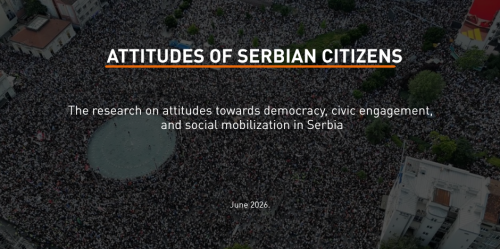
Six in ten citizens of Serbia believe that democracy is the best political system, yet the same proportion believe that democracy in Serbia does not actually work. Citizens, in other words, have not lost faith in democracy as such; they have lost confidence that the state functions democratically. This is what the latest public opinion survey shows, conducted in June 2026 by CRTA and the Democracy Action Lab (DAL) at Stanford University.
The findings point to strikingly polarized attitudes among citizens, depending on their political preferences as well as their sources of information. Those who rely primarily on pro-government media, including the public broadcaster, hold diametrically opposed views on democracy, corruption, and institutions compared to those who follow critically oriented media or get their news from social networks. Serbian society effectively functions as two parallel realities: democracy as the best system of government is supported by 85 percent of supporters of the Student List, compared with just 38 percent of Serbian Progressive Party (SNS) voters.
Two thirds of citizens believe that the President and the government must respect constitutional limits regardless of the level of public support they enjoy, and that presidential power without parliamentary oversight is unacceptable. However, once political preferences are taken into account, around 80 percent of the ruling party’s supporters consider unchecked executive power justified, compared with only 2 percent of those aligned with the Student List.
Only about a third of citizens say they trust political institutions. 34 percent trust the government, and 31 percent trust the National Assembly. Citizens’ trust in institutions is eroding. Trust in the presidency has nearly halved in three years: in February 2023, 60 percent of citizens expressed trust in the President, compared with just 35 percent today. In contrast to political institutions, state universities and the church remain institutions in which a majority of citizens place their trust. 71 percent trust state universities, followed by 64 percent who trust the Serbian Orthodox Church.
More than half of Serbia’s citizens consider corruption to be an extremely serious problem. When it comes to responsibility for its prevalence, 38 percent blame the political system as a whole, while an additional 16 percent specifically blame the current government. SNS voters, by contrast, attribute responsibility to the previous government and to the “Serbian mentality.”
The protests triggered by the collapse of the canopy have shown no decline in support even a year and a half later. Support for the protests has remained stable at 60 percent, a trend consistent since April of last year. Nearly two thirds of citizens (62 percent) are concerned about the use of police force against protest participants.
In the context of anticipated early parliamentary elections, support for the protests is translating into potential votes for the Student List. Nevertheless, a non-negligible share of citizens, despite widespread support for the protests, distrust in state institutions, and dissatisfaction with the state of the country, remain politically undecided (12 percent) or say they will not vote at all (9 percent). Among decided voters (70 percent), 44.9 percent would currently vote for the Student List, 35.7 percent for SNS and 3.8 percent for the Socialist Party of Serbia (SPS). No other political actor independently clears the electoral threshold.
The survey was conducted between 10 and 24 June 2026, using face to face interviews with a representative sample of 2,324 adult citizens of Serbia.
Read the full survey here.