Institutions responsible for implementing laws and protecting voter rights did not, through their work, sufficiently contribute to protecting the public interest and achieving a higher degree of standards for free and democratic elections. Those institutions that did react to law breaches during the campaign did not influence a change in behaviour of those electoral actors who abused their institutional advantages in the election campaign.
Latest Updates
On behalf of CRTA, I would like to thank you for the opportunity to address the Committee. The election campaign in Serbia started with diversity in the election offer but in less favorable conditions for parties that do not constitute the ruling majority. The course of the campaign, so far, shows the presence of issues which burdened previous Serbian elections, also erasing the line between the state and party: abuse of state resources and office, pressures on voters, vote-buying and other forms of electoral corruption.
CRTA has formed the largest election observation mission so far, that will assess the quality of voting process at presidential, parliamentary and Belgrade elections on April 3. More than three thousand of observers, trained in accordance with the highest international standards, will monitor elections, which is twice more observers than in 2020 elections.
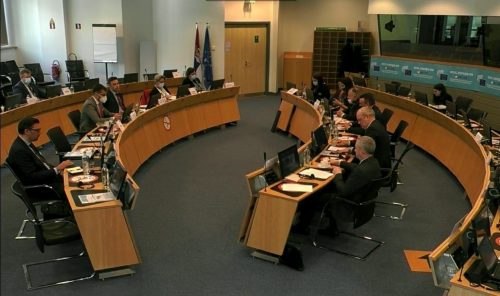
On behalf of CRTA, I would like to thank you for the opportunity to address the Delegation. 2022 Elections will take place in the shadow of the Russian invasion of Ukraine. Serbian authorities’ hesitation to fully align with the EU foreign policy is an outcome of a long-trend Russian political and economic influence and Serbian energy dependency from Russia. The context of war and lack of straightforward policies may intensify tensions in the ongoing election campaign. Pro-regime media are exploiting the war to glorify Russia and create new narratives that the president is heroically resisting pressures in securing Serbian independence. The election campaign in Serbia started with diversity in the election offer but in less favorable conditions for parties that do not constitute the ruling majority.
The analysis showed that, in the absence of the official statements due to the state’s long hesitation to determine, mainstream pro-regime media reported dominantly in favour of Russia. In their reporting, they admired the supremacy of the Russian army and Putin’s determination to confront the West, creating a narrative of Russia as a victim. This was…
There has been a lot of talks on social networks and media recently about whether party activists can knock on citizens’ doors asking them for whom they will vote. The question that has logically arisen is whether a door-to-door campaign is allowed or not.
Erasing the line between state and party interests, and a strong commitment of government representatives to use state institutions as a means to secure support to the ruling party and to build a personality cult around Aleksandar Vučić, with contributions by mainstream media, marked the “campaign before the campaign”, as shown by the CRTA Election…
On February 4th, Members of Parliament adopted a set of new laws regulating the conduct of the election process. These laws came into force on February 7th, meaning that the changes were adopted just before the calling of the election campaign, and less than two months before the election day announced for April 3, 2022….
Findings of the “political pluralism monitoring” in television programs, conducted by the Regulatory Authority for Electronic Media (REM) and presented to the public by the Temporary Supervisory Body for Media Monitoring, do not paint a credible picture of the objectivity and professionalism of the mainstream media scene in Serbia, or the representation of political actors in television reporting.