CRTA’s address at the joint hearing of the European Parliament’s Special Committee on the European Democracy Shield and the Committee on Foreign Affairs
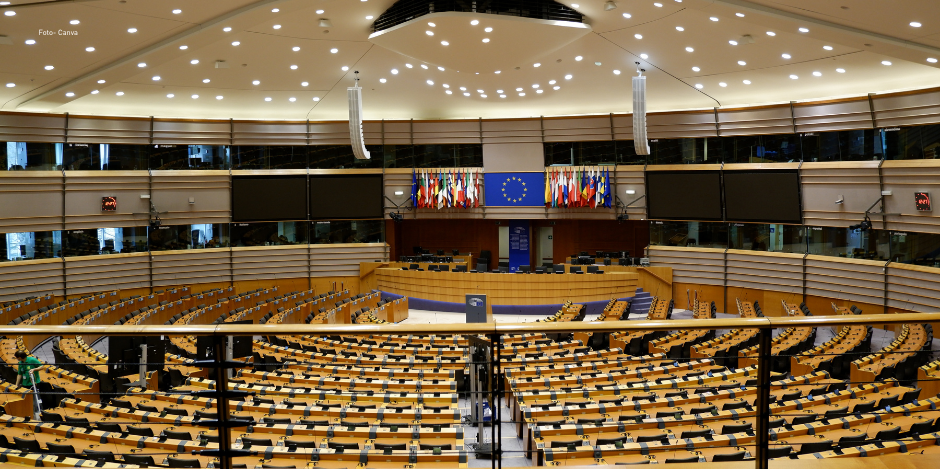 European Parlament / Photo – Canva
Serbia today is increasingly described by citizens as Ćaciland. What is Ćaciland – this impossible-to-translate word? It refers to the space between the Presidency and the National Assembly, in the very centre of the capital, where individuals with serious criminal records, including war crimes, camp and operate openly. They physically and verbally attack journalists, activists, MPs and ordinary citizens. They act as an informal enforcement structure aligned with those in power, while police officers stand by passively, effectively protecting them.
Most strikingly, the same individuals operating in Ćaciland now appear as part of para-observer missions linked to political parties and GONGOs. Ćaciland has become a symbol of institutional power overtaken by a criminal cartel.
At the same time, Serbia’s political-media ecosystem produces an unprecedented volume of propaganda. This propaganda of the government-controlled media generates deep public distrust, undermines confidence in Western democracies, and normalises narratives that delegitimise the EU, independent institutions and civic movements, mirroring Kremlin messaging, including claims that democratic change in Serbia is a foreign-engineered “colour revolution”.
What unfolded this past Sunday in three municipalities cannot be described as an election. CRTA’s Election Observation Mission was forced to withdraw from one municipality after two young female observers were surrounded, trapped in their car and violently attacked by regime-affiliated groups of criminals. Police were metres away and did nothing. This is the third time CRTA has had to abort its mission due to safety threats.
This is no longer about irregularities. It is about the criminalisation of the electoral framework. Instead of democratic competition, elections are dominated by organised violence and actors who operate entirely above the law.
For more than a decade, the ruling SNS has fused state and party so completely that real electoral competition has been dismantled. ODIHR’s findings on the December 2023 elections confirmed what citizens already knew: the electoral environment is fundamentally distorted through systemic abuse of public resources, coercion of public-sector employees, domination of the media landscape, and targeted voter-migration practices. This is not a system with irregularities, it is a system built on irregularities.
The EU cannot wait for another flawed election to react. Under current conditions, Serbia’s next elections will not be free or fair and might initiate violence on a wider scale.
The effectiveness of the Unified Voter Register law update depends entirely on political will, which is totally absent.
What we are asking for is clear and practical:
1. Early, continuous and long-term monitoring
Not only election-day observation. We need robust and continuous monitoring that deters the misuse of state resources, captured media, and the suppression of fair competition.
Such measures must be directed at political actors responsible for abuses, not at the citizens who already bear the consequences.
2. Enforced protection of independent domestic observers
Attacks on observers must carry consequences.
The EU must openly address the phenomenon of “parallel observers” linked to ruling parties, who legitimise fraudulent elections.
3. Direct communication with citizens
Communication not only with elites. Citizens are exposed to relentless anti-EU, anti-West propaganda from both domestic and foreign actors. The EU must engage directly to counter these narratives.
4. Stronger support for civil society
Civil society is the backbone of democratic resilience, a safety net when institutions collapse. Support must be strategic, long-term, and directed at breaking the culture of impunity.
These are not ambitious demands.
They are the minimum necessary to prevent irreversible damage to trust in elections and democratic institutions.
For more than two decades, CRTA has been on the front line of the fight for democracy in Serbia – fact-checking public narratives, countering disinformation, documenting election abuses, defending civic space, and exposing the systematic dismantling of democratic institutions.
Yet today, Serbia confronts a far more dangerous phase, where criminalised institutions, systemic electoral manipulation and a weaponised information ecosystem reinforce each other. The country increasingly mirrors Russian disinformation tactics, where the main threat is not just foreign (FIMI) but domestic information manipulation and interference (DIMI).
One of the central ideas in this playbook hints that democratic changes in Serbia are depicted as part of a broader foreign agenda. This serves to normalise Kremlin-aligned narratives.
We have seen that the disinformation generated within Serbia’s political-media ecosystem spreads across the Western Balkans, fuelling polarisation and weakening democracies. Investigations by independent journalists reveal that 204 Russian nationals, including individuals tied to the FSB, sanctioned oligarchs and war profiteers, were granted Serbian citizenship under opaque “national-interest” decrees, effectively turning Serbia into a gateway for circumventing EU sanctions.
Meanwhile, destabilising actions connected to Serbia raise serious concerns for European security: the unresolved 2023 Banjska attack in Kosovo; media reports of Russian-linked groups using a resort in western Serbia to train individuals to incite unrest ahead of Moldova’s elections; and Serbian citizens arrested for hate-motivated crimes in Paris and Berlin. These are not isolated episodes. They fit a pattern of hybrid interference that stretches far beyond Serbia’s borders.
Bearing all of this all in mind, it remains clear that the future of democracy in the Western Balkans cannot be safeguarded through declarations alone.
It requires clarity, consistency and courage.
The European Union must recognise that what is unfolding in Serbia is not an isolated case of democratic backsliding, but a systemic challenge with direct implications for European stability and security.
When electoral processes are criminalised, when institutions are captured, and when disinformation is weaponised, the cost of inaction becomes far greater than the cost of engagement.
We ask you not to leave Serbia’s citizens to face this alone. Serbia urgently needs principled allies committed to defending democratic integrity. An empowered civil society and engaged citizens remain the last line of defence against democratic erosion.